What happens in the eye
The eye functions in many ways like a highly refined optical system, similar to a camera — but far more complex.
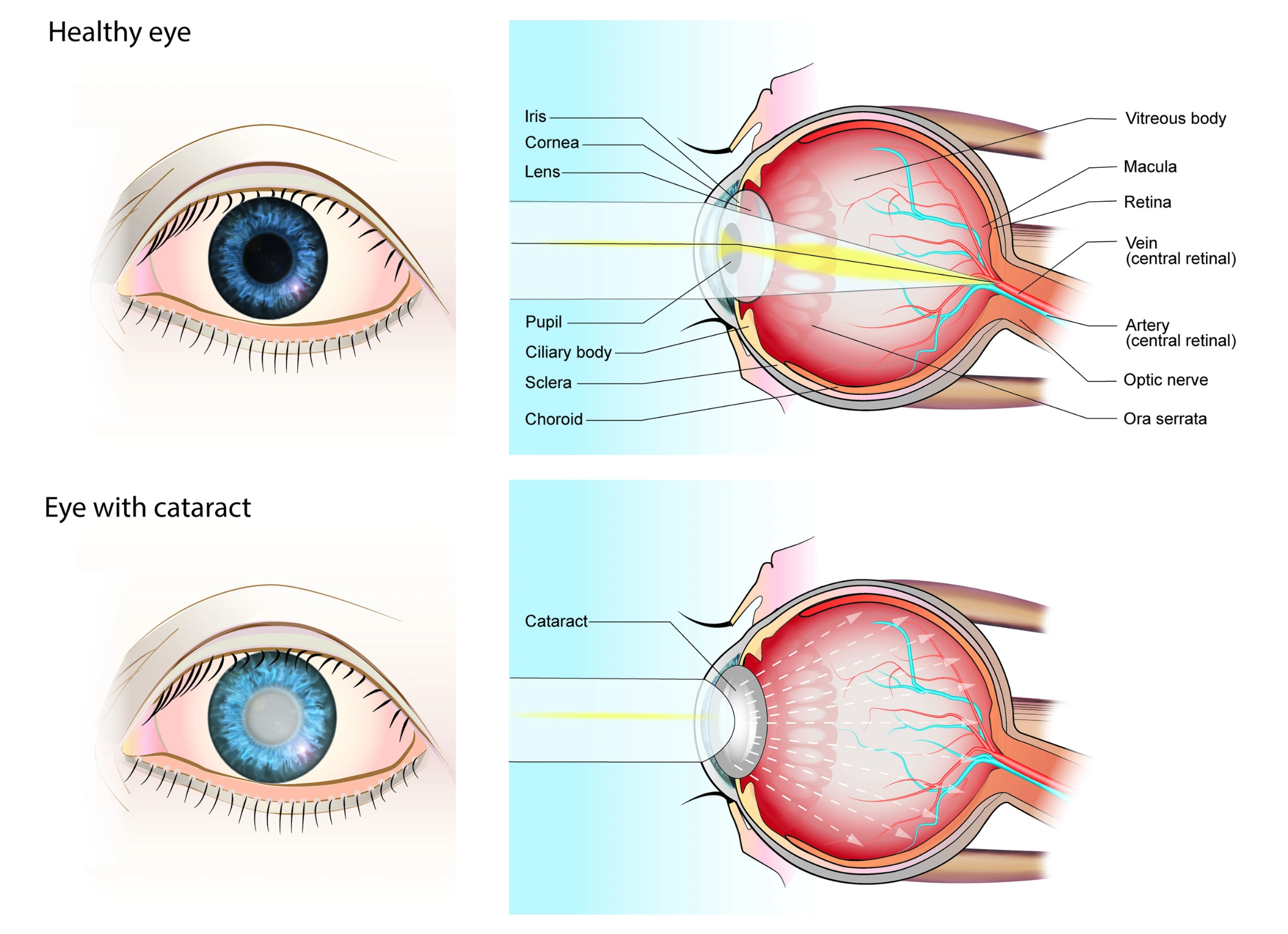
Light enters the eye through the cornea (the clear front surface) and passes through the pupil, where the amount of incoming light is controlled by the iris. From there, light reaches the natural lens, which plays a critical role in focusing that light precisely onto the retina at the back of the eye.
The retina then converts this light into electrical signals, which are transmitted via the optic nerve to the brain, where images are interpreted.
In a healthy eye
- The lens is clear and transparent, allowing light to pass through without obstruction
- The lens remains flexible, enabling accurate focusing at different distances
- Light is precisely focused onto the retina, producing sharp, detailed images
- Visual signals are transmitted clearly, resulting in crisp, high-contrast vision
With a cataract
Over time, structural changes occur within the lens:
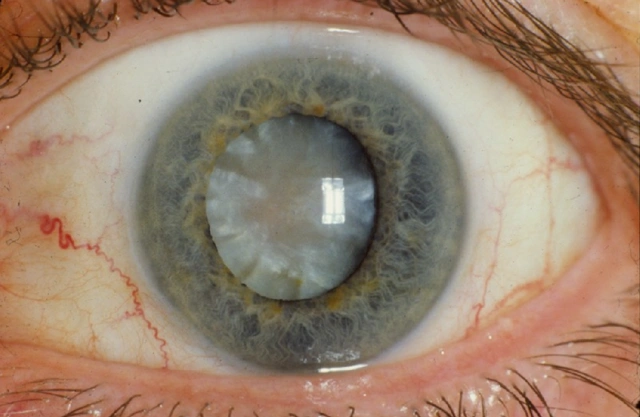
- The normally clear lens becomes clouded due to protein changes
- Light passing through the lens is scattered instead of precisely focused
- The amount of light reaching the retina is reduced and irregular
- Image quality deteriorates, leading to blurred, hazy, or distorted vision
How this affects what you actually see
Rather than simply “blurred vision,” patients often notice more specific changes:
- A loss of contrast (objects appear less defined or “flat”)
- Increased glare and halos, especially around lights at night
- Difficulty seeing in bright conditions due to light scatter
- Colours appearing faded, dull, or yellowed
- A general sense that vision is not as clear or sharp as it used to be
How Cataracts develop
Cataracts do not develop suddenly. They form gradually over time as a result of structural and biochemical changes within the natural lens of the eye.
The lens is made up primarily of water and specialised proteins arranged in a highly organised structure. This precise arrangement allows the lens to remain clear and to focus light accurately onto the retina.
What changes over time?
As part of the natural ageing process — and sometimes due to other factors — these lens proteins begin to change:
- The proteins can break down and clump together
- The orderly structure of the lens becomes disrupted
- The lens gradually loses its transparency and flexibility
This leads to the development of small cloudy areas within the lens, which may initially be too subtle to notice.
Why vision changes gradually
In the early stages, these changes affect only a small portion of the lens. The rest of the lens can still transmit light effectively, so vision may remain relatively good.
As the cataract progresses:
- Clouding becomes more widespread
- Light passing through the lens becomes increasingly scattered
- The lens may become denser and less flexible
- Visual clarity steadily declines
Because this process is typically slow, many patients adapt to the changes without realising how much their vision has altered.
Types of Cataracts
Cataracts are not all the same. They can develop in different parts of the lens, and the location of the change directly influences how vision is affected and how symptoms are experienced.
Understanding the type of cataract helps explain why some people struggle with glare, others with reading, and others with general blurring of vision.
Nuclear Cataracts (Central Lens)
Nuclear cataracts develop in the central part of the lens (the nucleus) and are the most common type associated with ageing.
What happens:
- The central lens gradually becomes denser and yellowed
- The lens may harden over time
- Light transmission becomes less efficient
How vision is affected:
- Gradual decline in distance vision
- Colours may appear yellowed or less vibrant
- In some cases, temporary improvement in near vision (“second sight”)
Clinical insight:
This type often progresses slowly and may go unnoticed initially, as patients adapt to the changes over time.
Details the progression of the nuclear cataract, the most common type of cataract, showing a gradual hardening of the nucleus, expanding to other layers of the lens, potentially causing severe vision loss which can only be restored through surgery.Cortical Cataracts (Outer Lens)
Cortical cataracts begin in the outer edges of the lens (the cortex) and extend inward in a spoke-like pattern.
What happens:
- White, wedge-shaped opacities develop
- These changes disrupt how light enters from the periphery
How vision is affected:
- Increased glare and light sensitivity
- Difficulty with night driving
- Halos around lights
- Fluctuating vision depending on lighting conditions
Clinical insight:
Symptoms are often more noticeable in bright or low-light environments due to light scatter.
Details progression of cortical sclerosis cataracts, starting as a small spoke-like opacity which grows around the edge of the lens, potentially causing severe vision loss which can only be restored through surgery.Posterior Subcapsular Cataracts (Back of Lens)
These cataracts form at the back surface of the lens, just in front of the posterior capsule.
What happens:
- A small but dense opacity develops centrally at the back of the lens
- Even a small cataract in this location can significantly affect vision
How vision is affected:
- Difficulty with reading or near tasks
- Reduced vision in bright light
- Glare and halos
- Often progresses more quickly than other types
Clinical insight:
This type tends to cause symptoms earlier and more noticeably, even when the cataract is relatively small.
A posterior subcapsular cataract is a small opacity at the back of the lens, which can have significant symptoms early on and can develop rapidly. We appreciate Dr. Sandy Feldman for lending his expertise on this piece.What Cataracts Are Not
Cataracts are often misunderstood. Many patients have heard descriptions that are not medically accurate, which can lead to confusion about symptoms, progression, and treatment.
Understanding what cataracts are not is just as important as understanding what they are.
Cataracts are not a film or layer growing over the eye
A common misconception is that cataracts form as a “film” on the surface of the eye.
- In reality, cataracts develop inside the eye, within the natural lens.
- The front surface of the eye (the cornea) remains clear.
This is why cataracts cannot be wiped away or treated with surface-based drops.
Cataracts are not a separate growth or foreign object
Cataracts are not something new that appears in the eye.
They are a change in the existing lens structure, where the normally clear lens becomes cloudy over time.
Nothing is “added” — the lens itself is altered.
Cataracts are not caused by overusing your eyes
Reading, screen use, or focusing for long periods does not cause cataracts.
Cataracts are primarily related to:
- Ageing
- Metabolic changes
- Environmental and medical factors
Eye strain may cause temporary discomfort, but it does not lead to cataract formation.
Cataracts cannot be reversed with medication or eye drops
There are currently no proven medications or eye drops that can reverse or remove cataracts.
- Glasses may improve vision temporarily in early stages
- But they do not stop or reverse the underlying process
Definitive treatment involves surgical removal of the cloudy lens.
Cataracts are not always the cause of blurred vision
Not all vision changes are due to cataracts.
Other conditions can produce similar symptoms, including:
- Retinal diseases
- Glaucoma
- Diabetic eye disease
- Corneal conditions
This is why a proper eye examination is essential before assuming cataracts are the cause.
Cataracts do not always require immediate surgery
Another common misconception is that cataracts must be removed as soon as they are diagnosed.
In reality, treatment depends on:
- The level of visual impact
- How symptoms affect daily life
Many cataracts are monitored until they begin to interfere with function.
Cataracts do not “spread” from one eye to the other
Each eye develops cataracts independently.
- One eye may be more affected than the other
- Progression can occur at different rates