How lens choice affects vision
The type of lens selected can influence:
- Whether you see clearly at distance, near, or both
- Your dependence on glasses after surgery
- How your vision performs in different lighting conditions
- The quality of contrast and clarity
Lens choice is therefore an important part of surgical planning.
There are many IOL options available for cataract patients. This video teaches patients about the visual zones, and the main IOL options for them to consider.Types of intraocular lenses
Monofocal lenses
Monofocal lenses are the most commonly used lenses.
They are designed to provide clear vision at a single focal distance, usually set for distance vision.
What to expect:
- Good distance vision
- Glasses usually required for reading or near work
Clinical perspective:
Monofocal lenses offer reliable, high-quality vision and are suitable for many patients.
This Topic is an overview of how the natural lens loses its accommodation as we age, and emphasizes the inability of conventional artificial lenses to allow perfect vision following cataract surgery .Extended depth of focus (EDOF) lenses
These lenses are designed to provide a range of vision, particularly from distance to intermediate.
What to expect:
- Good distance and intermediate vision
- Reduced dependence on glasses for some activities
- Reading glasses may still be needed for fine print
Clinical perspective:
These lenses aim to balance visual range with quality, but outcomes can vary between individuals.
Explains how an extended depth-of-focus (EDOF) IOL (such as the TECNIS Symfony) offers a continuous range of vision and minimizes side effects of other IOLs. We are grateful to Dr. Timothy McGarity of Restoration Eye Care and Dr. Leiv Takle Jr. of Takle Eye Group for advising us on this video.Multifocal lenses
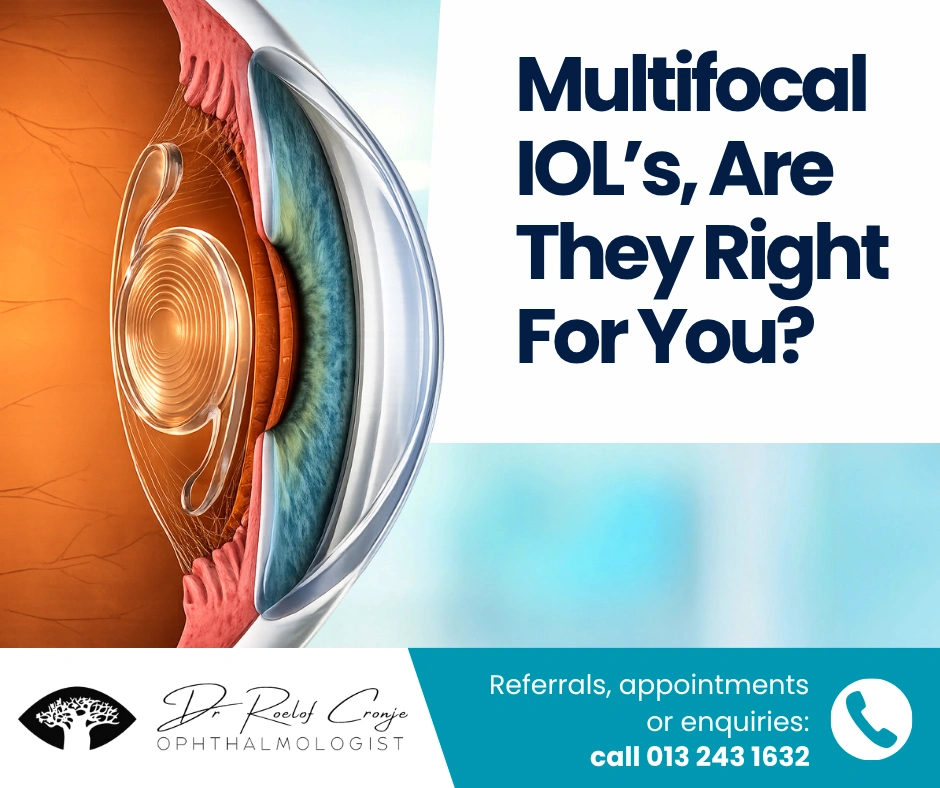
Multifocal lenses are designed to provide vision at multiple distances, including near and distance.
What to expect:
- Reduced dependence on glasses for many tasks
- Ability to see at more than one distance
Considerations:
- Possible halos or glare around lights
- Reduced contrast in some situations
Clinical perspective:
These lenses require careful patient selection and realistic expectations.
Describes the difference between single focus IOLs and Multifocal IOLs, which provide correction for near and distance vision. Notes that some patients may experience halos or ghost images at night at first, but that in most cases, the brain will adapt. Generic style IOL shown.Toric lenses (for astigmatism)
Toric lenses are designed to correct astigmatism, a common condition that affects how light is focused.
What to expect:
- Improved clarity for patients with astigmatism
- Reduced dependence on glasses for distance vision
Clinical perspective:
Astigmatism correction can significantly improve visual quality when appropriately addressed.
Describes the nature of astigmatism, and shows how a toric lens implant following cataract surgery can act to neutralize the astigmatism, though near and distance vision will be unaffected.How lens selection is decided
Choosing the right lens is a personalised process.
It is based on:
- Your visual priorities (distance vs near tasks)
- Your lifestyle (e.g. driving, reading, screen use)
- Whether you prefer to reduce dependence on glasses
- The health of your eyes
- The presence of astigmatism or other conditions
There is often a balance between:
- Visual range
- Visual quality
- Potential side effects
A detailed discussion helps ensure the most appropriate choice.
An overview of what lifestyle factors could be important considerations for the type of IOL a patient chooses. Special thanks to Kristin Mills of Ludwick Eye Center and Dr. Keith Liang of Center for Sight for lending their expertise on this topic.Setting realistic expectations
While modern lenses can significantly improve vision, it is important to understand that:
- No lens perfectly replicates the natural lens
- Some patients will still need glasses for certain tasks
- Visual outcomes vary depending on individual factors
The goal is to achieve the best functional vision for your needs, not necessarily complete independence from glasses.
Lens options and overall eye health
Not all lens types are suitable for every patient.
Certain eye conditions may influence which options are appropriate, including:
- Retinal disease
- Glaucoma
- Corneal conditions
- Previous eye surgery
This is why lens selection must always be guided by a full clinical assessment.