
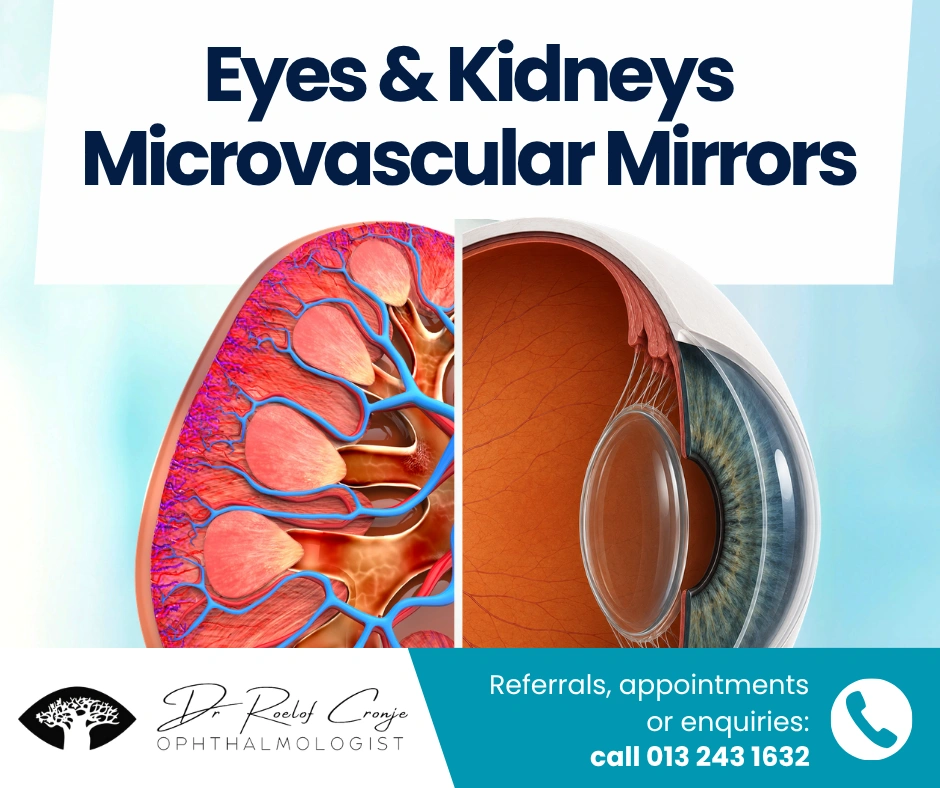
At first glance, eyes and kidneys seem like very different organs. But from a microvascular point of view, they’re remarkably similar. Both depend on dense networks of tiny vessels, and both are vulnerable to the same systemic insults: diabetes, hypertension, inflammation and endothelial dysfunction.
The crucial difference is that we can actually see the retinal circulation, while the kidney’s microvasculature remains hidden. That’s why retinal findings have become an important marker of both current kidney status and future kidney risk in multiple studies and meta-analyses.PubMed+2Nature+2
For GPs, optometrists and emergency clinicians, this means a routine eye exam can sometimes flag kidney disease years before patients develop symptoms or marked biochemical changes.
The Eye–Kidney Connection: Microvascular Parallels
The retina and the glomerulus share key structural features: fine capillary loops, high metabolic demand and tight autoregulation of blood flow. Microvascular abnormalities in the kidney are a common histopathologic finding in chronic kidney disease and renal failure; similar microvascular changes can be imaged non-invasively in the retina.AJKD+1
Large population studies and systematic reviews have shown that:
- Retinal microvascular signs (microaneurysms, haemorrhages, cotton-wool spots, AV nicking, arteriolar narrowing) are associated with prevalent CKD and predict incident CKD or ESRD in various cohorts.PLOS+2MDPI+2
- Patients with CKD demonstrate reduced retinal vascular density and structural microvascular changes on OCT-A compared with controls.PMC+2Nature+2
So when you see retinal microvascular disease, you’re often looking at the same pathological processes that are active in the kidneys — just in a visible format.
A Diabetes Case: How Retinopathy and Nephropathy Travel Together
Imagine a 52-year-old man with type 2 diabetes for eight years. He feels well and attends a routine eye exam. On fundoscopy you note:
- scattered microaneurysms,
- dot-blot haemorrhages,
- a few cotton-wool spots,
- early venous beading.
This picture of non-proliferative diabetic retinopathy is more than a local eye finding. Multiple longitudinal studies have shown that:
- The presence and severity of diabetic retinopathy correlate with urinary albumin excretion and the development or progression of diabetic kidney disease.Frontiers+3Lippincott Journals+3PLOS+3
- Retinopathy and microalbuminuria together can predict macroalbuminuria and renal function decline.Diabetes Journals+1
- More recent work suggests DR is especially predictive in people with diabetes who still have preserved kidney function, highlighting its value as an early warning sign.PubMed+1
In other words, your patient’s retinopathy strongly suggests that glomerular microvascular injury is already underway, even if his eGFR is still technically “normal” and he feels fine.
Practical takeaway: In a person with diabetes, treat any retinopathy as a trigger for a structured renal review (ACR, eGFR, BP, and cardiovascular risk assessment), rather than dismissing it as an isolated eye issue.
Retinal Signs That Should Make You Think “Kidneys”
Diabetic Retinopathy (DR)
DR is one of the best-studied ocular markers of renal risk. Cohort studies in both Asian and Western populations show that baseline DR severity predicts later diabetic kidney disease and CKD progression.PLOS+2Nature+2
Key points:
- Microaneurysms, haemorrhages and cotton-wool spots reflect capillary leakage and focal ischaemia — mechanisms that are also central in diabetic nephropathy.AJKD+1
- As DR progresses (e.g. more extensive haemorrhages, venous beading, IRMA, PDR), the likelihood of concurrent or impending nephropathy rises.PLOS+1
You don’t need PDR to worry about the kidneys; even “mild” NPDR can be clinically meaningful in risk stratification.
Hypertensive Retinopathy (HR)
Hypertensive retinopathy is another important microvascular mirror. While early studies showed mixed results, more recent work has found that more severe grades of HR are associated with greater CKD severity and progression.
Typical correlations:
- Generalised arteriolar narrowing and AV nicking are markers of long-standing vascular resistance.
- Cotton-wool spots and haemorrhages suggest more advanced small-vessel injury and local ischaemia.IOVS
- Disc oedema in a hypertensive patient can indicate malignant hypertension or a hypertensive emergency, frequently accompanied by acute kidney injury or rapidly progressive CKD. (Evidence here is largely from hypertensive emergency and malignant hypertension series.)
One study in hypertensive Nigerians concluded that HR and renal damage tend to occur pari passu as consequences of long-standing hypertension, and that HR should prompt further renal assessment.
Clinical implication: if you see new or worsening HR — especially cotton-wool spots, haemorrhages or disc swelling — it’s reasonable to consider this a red flag for underlying or progressive CKD and to investigate accordingly.
Cotton-Wool Spots and Retinal Vasculitis in Non-Diabetic Patients
Cotton-wool spots (CWS) represent focal retinal nerve fibre layer infarcts from capillary non-perfusion. They’re common in diabetes and hypertension, but they also occur in systemic autoimmune and vasculitic disease.PMC+2Lippincott Journals+2
In systemic lupus erythematosus (SLE), for example:
- The most common retinal manifestation is a microangiopathy characterised by CWS and small intraretinal haemorrhages.Review of Ophthalmology+1
- Retinal involvement often coexists with lupus nephritis or other systemic vascular complications.PMC+1
So when CWS appear in a non-diabetic, non-hypertensive patient — especially if there are signs of vasculitis or occlusive disease — it’s appropriate to consider systemic autoimmune causes (e.g., SLE, vasculitis, thrombotic microangiopathy) and to be mindful that the kidneys may be involved.
How Strong Is the Evidence Overall?
A 2021 systematic review and meta-analysis concluded that retinal microvascular signs provide useful information about concurrent kidney disease and future risk of CKD progression, particularly in people with diabetes and hypertension.PubMed
Other cohort and imaging studies have found:
- Retinal vascular calibre changes, DR and other microvascular signs are associated with incident CKD and ESRD in large population samples.
- Retinal vessel density and flow changes on OCT-A correlate with CKD stages and blood pressure control, reinforcing the concept of shared microvascular pathology.PMC+2Nature+2
At the same time, not every study finds a strong predictive relationship in every setting, and retinal signs shouldn’t be used as a stand-alone diagnostic test for kidney disease. Rather, they’re best thought of as a non-invasive risk marker that adds to clinical judgement, blood pressure data, glycaemic control indices and standard renal labs.
Practical Guidance for Everyday Clinical Work
For Optometrists
When you see:
- diabetic retinopathy in a patient with known diabetes,
- hypertensive retinopathy (especially new or worsening),
- unexplained CWS or vasculitis-like changes in a non-diabetic,
it is reasonable, based on current evidence, to recommend medical review with:
- blood pressure assessment,
- glycaemic control (HbA1c),
- urine ACR,
- eGFR and basic biochemistry.PLOS+1
Including the retinal findings and your level of concern in the report helps the GP or physician frame the urgency and depth of renal workup.
For GPs and Physicians
When you receive a report noting DR, HR or suspicious microvascular changes, it can be useful to view these as a window into the rest of the patient’s vasculature, not just the eyes:
- In diabetes, DR severity should prompt careful staging of diabetic kidney disease and cardiovascular risk.PLOS+1
- In hypertension, HR — particularly with haemorrhages or disc swelling — should reinforce the importance of achieving and maintaining tight blood pressure control and checking for CKD.
- In suspected autoimmune or vasculitic disease, ocular microangiopathy and vasculitis often parallel renal involvement and should trigger appropriate rheumatologic and nephrologic assessment.PMC+2Review of Ophthalmology+2
Sharing back BP readings, A1c, ACR, eGFR trends and any renal diagnoses gives the eye specialist valuable context.
For Nephrologists
From the nephrology perspective, the retina functions almost like a non-invasive microvascular biopsy. Studies show that retinal microvascular signs and vessel density changes correlate with renal impairment and can predict progression, even after accounting for traditional risk factors.Atherosclerosis+2SpringerLink+2
Progressive retinopathy or worsening HR in a patient with CKD should be interpreted as a sign of ongoing endothelial injury and heightened cardiovascular risk, and may support intensifying risk-factor modification.
Communicating the Eye–Kidney Link to Patients
For patients, the idea that an eye exam can say something about kidney health is often surprising — and motivating.
A simple way to explain it:
“Your eyes and kidneys share the same kind of tiny blood vessels. When we see leakage or blockages in the eye’s vessels, it often means the same process is happening in the kidneys, just where we can’t see it.”
This explanation is consistent with the evidence that retinal microvascular abnormalities reflect systemic small-vessel disease, including in the kidneys.AJKD+1
It also helps patients understand why blood pressure control, glycaemic management and regular follow-up are not just “numbers exercises,” but ways to protect both vision and kidney function.
Bottom Line: Reading the Retina to Protect the Kidneys
Current research supports a clear message: retinal signs of kidney disease are real, clinically relevant and evidence-based — but they’re best used as part of a holistic risk assessment, not a diagnostic shortcut.
- Retinal microvascular changes are associated with concurrent CKD and can predict future renal decline, particularly in diabetic and hypertensive populations.PLOS+2Nature+2
- Diabetic retinopathy, especially at higher grades, is a recognised prognostic factor for CKD progression.PLOS+2Taylor & Francis Online+2
- Hypertensive retinopathy severity tracks with worse CKD stages and emphasises the need for close renal and cardiovascular monitoring.
For eye care professionals and medical clinicians working together, the message is simple: when the retina shows microvascular stress, it’s a valuable opportunity to look more closely at the kidneys — and sometimes to intervene while there is still time to change the trajectory.