
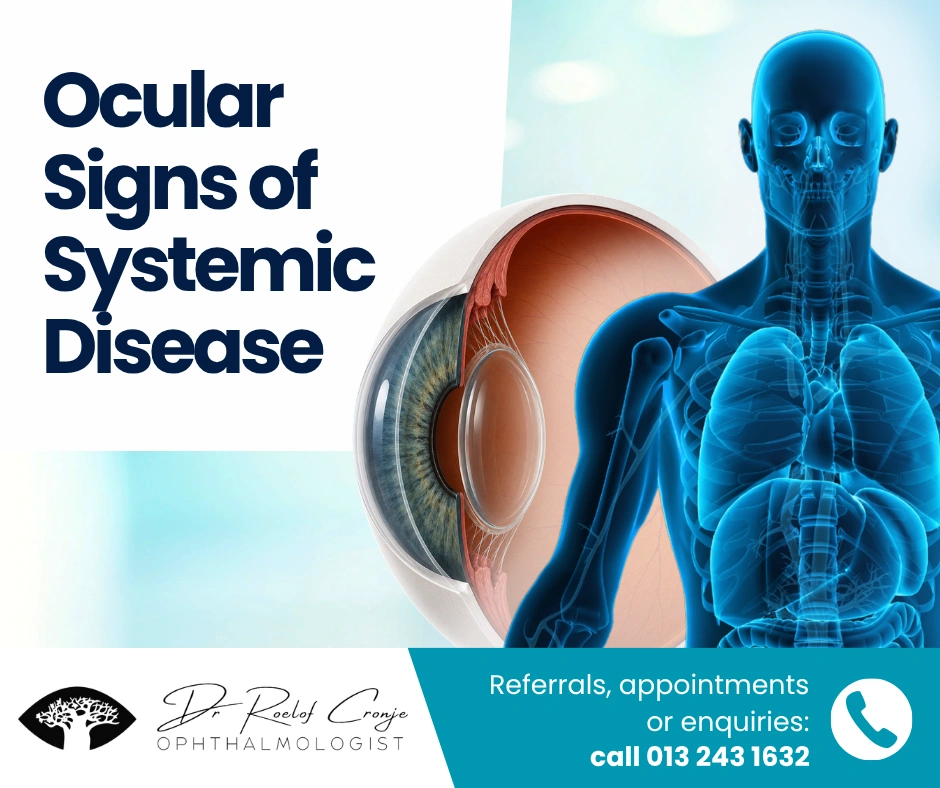
When the Eyes Reflect Systemic Health
The eye offers a unique view into the body’s circulatory and metabolic systems.
Subtle ocular findings often provide early clues to conditions affecting the heart, liver, or nervous system. For optometrists and general practitioners, recognising these ocular signs of systemic disease can guide timely referral and coordinated management.
This overview highlights five important examples where eye findings point beyond the orbit.
Roth Spots — Retinal Clues to Systemic Vascular Disease
Roth spots are white-centred retinal haemorrhages that indicate microvascular damage.
They are typically associated with infective endocarditis, leukaemia, severe anaemia, or hypertension. Their presence should prompt a focused systemic review for fever, murmurs, or haematological abnormalities.
Detecting Roth spots is an opportunity for early investigation before complications arise, reinforcing the importance of a thorough fundus examination in any patient with unexplained visual changes or systemic illness.
(Related reading: Neuro-Ophthalmology Red Flags)
Kayser–Fleischer Rings — The Ocular Hallmark of Wilson’s Disease
Kayser–Fleischer rings appear as golden-brown deposits at the corneal periphery.
They result from copper accumulation in Descemet’s membrane, most often due to Wilson’s disease, a rare inherited disorder of copper metabolism.
This finding is particularly important in younger patients presenting with neurological, hepatic, or behavioural symptoms of uncertain origin. Recognition of the ring should lead to referral for serum copper and ceruloplasmin testing.
(See also: Sudden, Painless Vision Loss: When to Refer Immediately)
Diabetic Retinopathy — A Marker of Microvascular Compromise
Diabetic retinopathy remains one of the most frequent ocular signs of systemic disease encountered in practice.
It represents the cumulative effect of chronic hyperglycaemia on the retinal vasculature, producing microaneurysms, haemorrhages, exudates, and, in advanced cases, neovascularisation.
These changes mirror the same microvascular injury that affects the kidneys and heart. Identifying early retinal findings allows for improved glycaemic control, cardiovascular risk management, and prevention of visual loss.
Hypertensive Retinopathy — The Fundus as a Cardiovascular Indicator
The retina is one of the few locations where the effects of hypertension can be observed directly.
Signs such as arteriolar narrowing, arteriovenous nicking, cotton-wool spots, and disc swelling correspond with the severity and duration of elevated blood pressure.
Advanced hypertensive retinopathy indicates target-organ involvement and requires urgent medical attention. For primary-care practitioners, retinal findings can assist in staging systemic disease and guiding management intensity.
Xanthelasma — A Local Sign of Systemic Lipid Imbalance
Xanthelasma presents as yellowish plaques near the eyelids, representing lipid deposition within the dermis.
Although often asymptomatic, it is frequently associated with hyperlipidaemia and may precede cardiovascular disease by several years.
Identifying xanthelasma should prompt lipid profiling and cardiovascular risk assessment. It is a straightforward but valuable ocular sign of systemic disease that highlights the link between ophthalmic and general health.
Why These Clues Matter
Ocular examination provides clinicians with an accessible view of systemic microcirculation and metabolism.
Recognising these findings fosters earlier diagnosis, multidisciplinary care, and better long-term outcomes for patients.
Close collaboration between ophthalmologists, optometrists, and GPs ensures that eye findings are not considered in isolation but as part of a patient’s overall health picture.
Key Takeaway
The eye can reveal early signs of systemic disease long before other organs show damage. Recognising and acting on these clues supports both vision preservation and overall health.